Beaches and swimming on Lake Norman.

Lake Life

Beaches and swimming on Lake Norman.

One public sand beach, a scattering of community shorelines, and a summer culture built around anchoring in a cove and getting in the water. Here is where swimming on Lake Norman actually happens, and how to do it well.

Chapter 01

Why there is only one public beach.

Lake Norman was built in 1963 when Duke Power impounded the Catawba River, and the shoreline was sold and developed rather than reserved. The result is 520 miles of edge that is overwhelmingly private: docks, seawalls, riprap, and lawns running to the water. Public access exists at boat ramps and a handful of parks, but sand — the kind you bring a towel to — exists in exactly one public place, the swim beach at Lake Norman State Park.

Chapter 02

The state park swim beach, in practice.

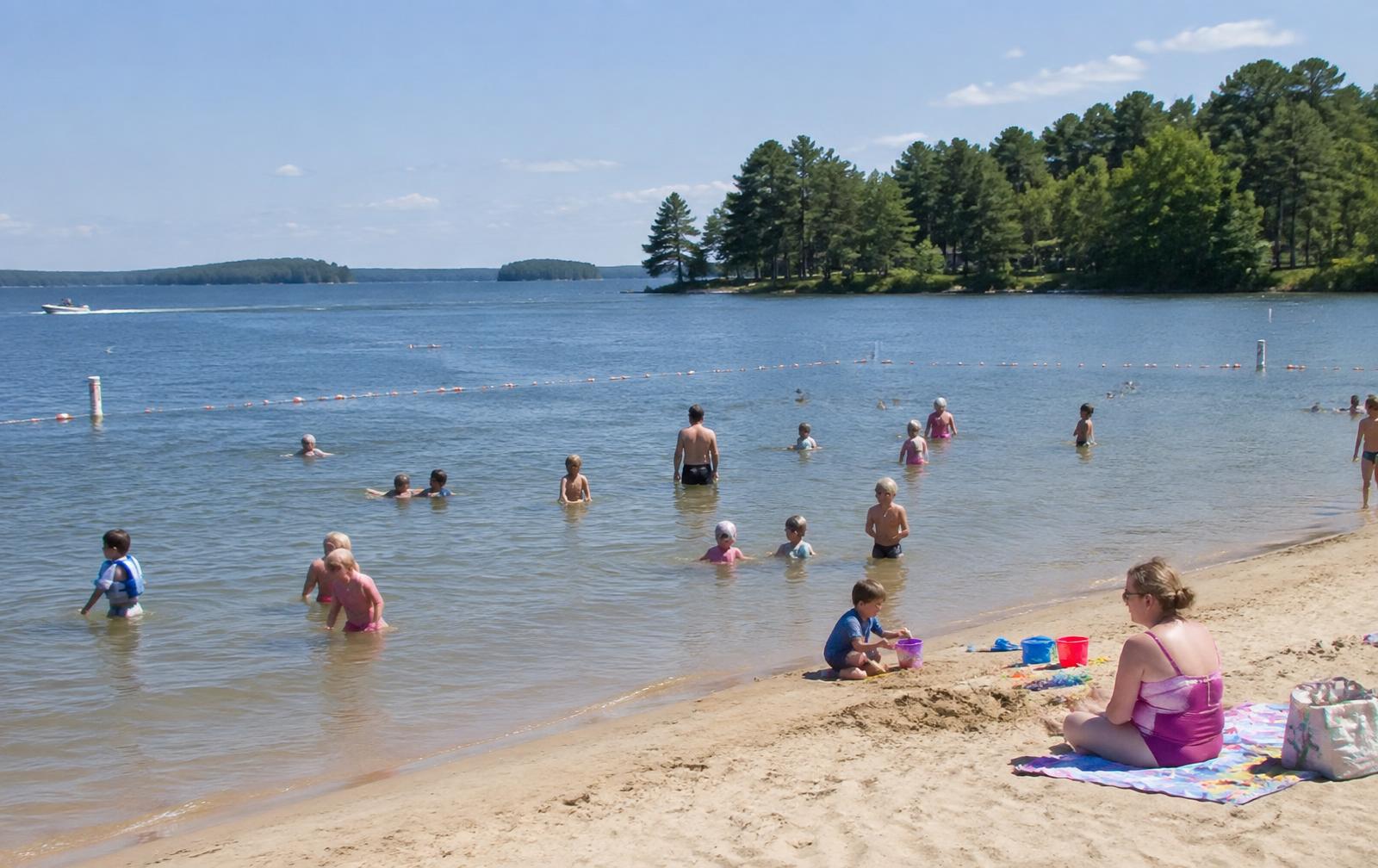
A crescent of imported sand on a shallow, slow-shelving cove on the Troutman peninsula, with a bathhouse, changing rooms, a roped swim area, and lifeguards on duty during posted hours from late May through early September. A modest per-swimmer fee applies in season. The lot fills by late morning on July and August Saturdays and the park turns cars away, so arrive before eleven or plan a weekday. Paddlecraft rentals share the same dock, which makes it the one place on the lake where a family with no boat can spend a full day on the water.
  • Only public sand beach on Lake Norman
  • Lifeguarded roped swim area in season
  • Bathhouse, changing rooms, and concession
  • Per-swimmer fee, no park entrance fee
  • Kayak and paddleboard rentals at the dock
  • Arrive before 11 a.m. on summer weekends

Chapter 03

Community beaches and neighborhood swim access.

A number of Lake Norman neighborhoods maintain their own waterfront: a sandy day-use shoreline, a swim dock or platform, a picnic lawn, sometimes a small marina. These are resident amenities, not public beaches, and they are one of the quieter differentiators between communities that otherwise look similar on paper. Buyers comparing waterfront neighborhoods should ask specifically whether the community water access includes a swim area, a ramp, slips, or only a view.

Chapter 04

Sandbars, swim coves, and the raft-up culture.

Most swimming on Lake Norman happens from a boat. Crews anchor in protected coves and on the shallow shoals that surface at normal pool, tie together, and stay put for the afternoon. The shoals are unmarked and their edges move with the water level and with sediment, so run in at idle, watch the depth, and set two anchors when a weekend crowd builds a wake. Coves off the main channel stay calmer and warmer; the main body chops up by early afternoon once the traffic starts.
  • Approach every shoal at idle speed
  • Set bow and stern anchors in a raft-up
  • Shallow coves run warmer than the channel
  • Fly a diver-down or swim flag when in the water
  • Watch for wake traffic on summer afternoons
  • Carry life jackets for every swimmer aboard

Chapter 05

When the water is warm enough.

Surface temperature is the whole calendar here. April sits in the sixties and feels cold. May climbs through the low seventies and the first swimmers appear. June through August holds low eighties, with shallow coves a few degrees warmer and the water near the Marshall and McGuire discharge areas warmer still. September stays swimmable for most people, and by late October the lake has turned over and the season is finished until spring.

Chapter 06

Safety, water quality, and the rules that matter.

Lake Norman is a working reservoir with routine water-quality monitoring and no chronic advisories; the practical rule is to give it a day or two after heavy rain, when creek runoff clouds the water. Swim inside marked areas where they exist, never swim near a dock's electrical service, and keep a flag up when people are in the water off a boat. Children should wear life jackets on docks and in the open water regardless of ability — depth drops quickly off most shorelines and the lake reaches well past a hundred feet near the old river channel.

Frequently Asked

Questions people ask about this.

Does Lake Norman have a public beach?
Yes — one. The swim beach at Lake Norman State Park in Troutman is the only public sand beach on the lake, with lifeguards during posted summer hours, a bathhouse, and a roped swim area. Every other stretch of sand on Lake Norman is private or attached to a community, marina, or restaurant.
Can you swim anywhere in Lake Norman?
Swimming is legal in open water across most of the lake, but shoreline access is the constraint: nearly all of the 520 miles of shoreline is privately owned. Public swimming realistically means the state park beach, a community beach if you live in one, or swimming from a boat anchored in a cove.
How warm is Lake Norman in the summer?
Surface temperatures typically climb into the low eighties by July and hold there through August, with the shallow coves running a few degrees warmer than the main channel. May and late September sit in the seventies — swimmable for most people but noticeably cooler at depth.
Are there sandbars on Lake Norman?
Yes. Several shallow shoals and sandbar areas draw raft-ups on summer weekends, most of them reachable only by boat. They are unmarked and shift with the water level, so approach at idle and read the depth finder rather than trusting last year's memory.
Is Lake Norman clean enough to swim in?
Lake Norman is a Duke Energy reservoir with generally good water quality and routine monitoring. Clarity drops for a day or two after heavy rain when runoff enters the creeks, which is the usual reason to wait before swimming rather than any ongoing advisory.
Do any Lake Norman communities have private beaches?
Several do. A number of waterfront neighborhoods maintain community beach areas, swim docks, or sandy day-use shoreline for residents and their guests, which is one of the amenities buyers weigh when comparing communities on the lake.
Ready to dig deeper into the lake?

See Water Temperature