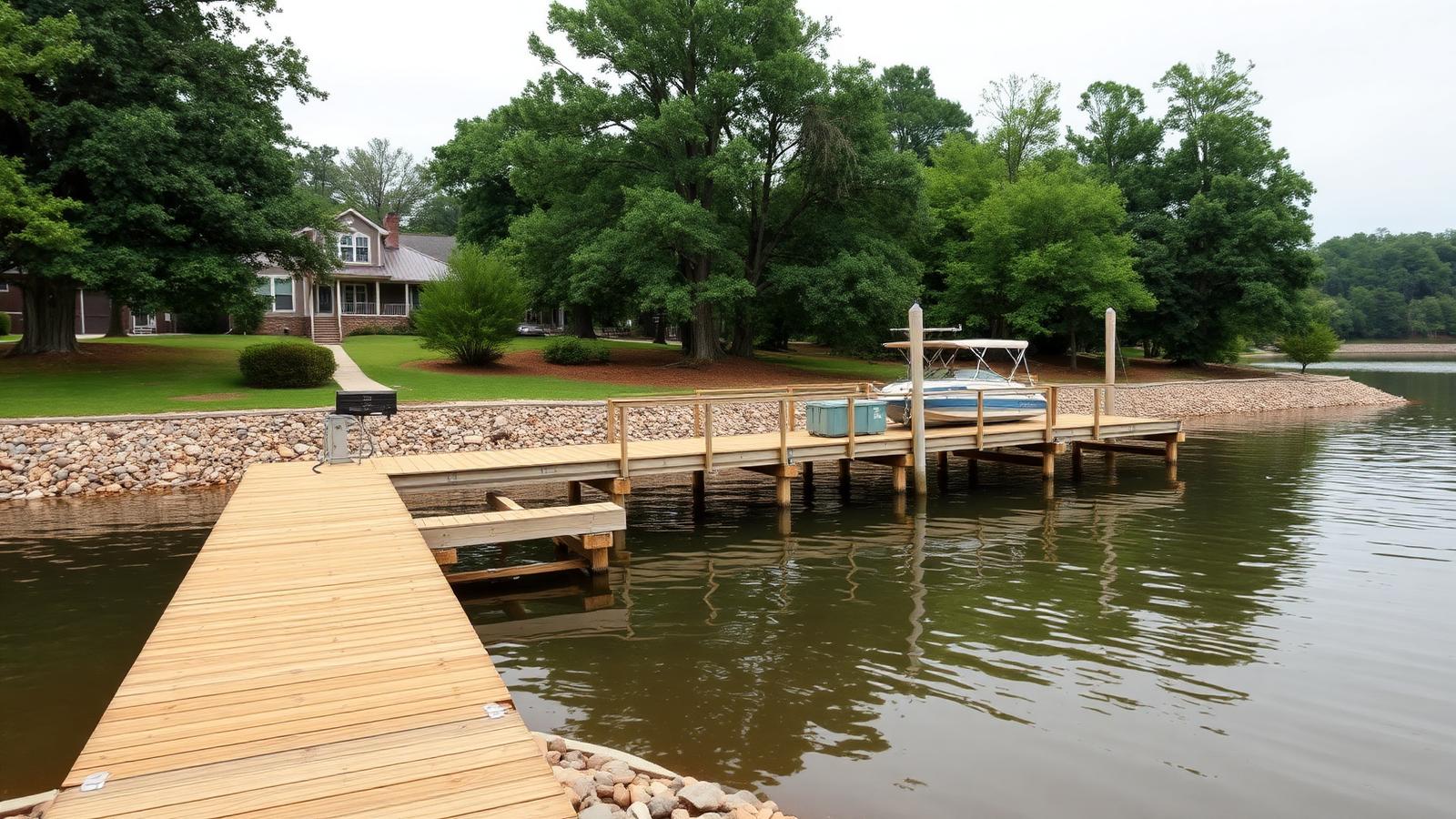
- Do you need a permit to build a dock on Lake Norman?
- Yes. Lake Norman's shoreline is managed by Duke Energy under a federal FERC license and the Catawba-Wateree Shoreline Management Plan. Any new pier, floating dock, boat lift, jet ski lift, dredging, riprap, seawall, or vegetation removal below the project boundary requires written Duke Energy authorization before work begins. County and municipal permits, and in some cases US Army Corps of Engineers review, may also apply.
- Who owns the shoreline on Lake Norman?
- Duke Energy holds property rights or flowage easements below the project boundary — generally at and below the 760-foot full pond contour plus a buffer. A waterfront homeowner owns to the project boundary and holds a permitted, revocable privilege to maintain a private facility beyond it. That is why docks are permitted rather than simply built.
- How long does dock approval take on Lake Norman?
- Timelines vary with season, complexity, and completeness of the application. Simple like-for-like repairs move fastest; new construction, dredging, and shoreline stabilization take longer because they involve site review and, sometimes, environmental or agency coordination. Experienced local dock builders generally handle the submittal and site staking on the owner's behalf.
- Can you dredge around a Lake Norman dock?
- Excavation below full pond requires Duke Energy authorization and may require additional agency review. Approvals typically address the volume and footprint of material removed, where spoil is placed, turbidity control, and protection of aquatic habitat. Dredging is not automatic and is evaluated case by case.
- Is riprap allowed on Lake Norman shoreline?
- Riprap is the most commonly authorized form of shoreline stabilization on the lake, and vertical seawalls are far more restricted. Stabilization work still requires authorization, must follow the approved contour and stone specification, and generally has to preserve or restore shoreline vegetation.
- Can you rebuild an existing dock on Lake Norman?
- Replacing, expanding, or substantially modifying an existing facility still requires Duke Energy authorization, and legacy structures are not automatically re-approved at their original size. Older grandfathered docks sometimes cannot be rebuilt to the same footprint under current standards.
- What is a shared or community dock?
- Many Lake Norman neighborhoods without individual shoreline frontage hold a permitted community pier, slip field, or boat slip assignment. Rights are typically governed by HOA documents and the underlying Duke Energy authorization, so slip availability, transferability, and maintenance obligations should be confirmed in writing before purchase.
- Does every waterfront home on Lake Norman have a dock?
- No. Some lots are deeded waterfront but cannot support a permitted dock because of water depth, cove width, shoreline classification, or existing setbacks from neighbors and the navigation channel. 'Waterfront' and 'dock-permittable' are two different questions and should be verified separately.